Sunday, March 20, 2016

Week 10 Reading Reflection

1) As a biology major I found most of this chapter pretty interesting because it included a lot of new information and perspectives on entrepreneurship that I do not see often. I did however find it very interesting that an entrepreneurial venture can be financed in multiple ways.

2) The sections on break-even analysis and operating budget were somewhat confusing to me. I would have liked to have seen more formulas or examples of these topics because even reading the text once or twice left me with some unanswered questions. 

3) Do you think budgeting is more accurate and effective if the entrepreneur handles it mainly by themselves or if they have a team to handle budgeting?

What do you think are the most effective ways to fund a start up?

4) I was not very knowledgeable on this chapter as opposed to some of the other readings we have had. So I feel like I learned a lot but took everything I read with a grain of salt because I need to become more informed on the entrepreneurial and financial budgeting topics presented.


Growing My Social Capital

1) One person must be a domain expert in your industry. This would be someone who's engaged in the same type of business activity as you would like to be. They may own the same kind of company that you would like to own, or they may be a technical expert who knows a lot about the kind of product or service that you would like to produce.
     Tato is a Dominican native from one of the villages that I helped last summer with BLUE. He only speaks spanish and is 50 years old. Interestingly enough he does not know his birthday, rather only knows his birth year. Tato has lived in La Yaroa, Dominican Republic (pop. under 500) for his entire life. Tato is my domain expert because he is a local who has previous skills in manual labor and basic plumbing, both of which are essential for a successful water project. Tato was an extremely experienced and hard worker on the water project in La Yaroa and loved what BLUE did for his community. With some negotiation we convinced him to join our team. Tato will soon be a paid employee of BLUE because his skills, experience, approachability, and hard work will help expedite our upcoming water projects over the next few months. In recent months BLUE has made it a priority to hire hard-working, skilled Dominican locals to help lead our trips alongside us. Tato is a great asset for us because he not only has the manual labor experience for successful water projects, but also has connections in the country for parts such as PVC tubes, shovels, and water faucets for us to use when completing the water projects.
2) One person must be an expert on your market. This would be someone who is targeting your market with similar products services -- or knows a lot about conducting customer research in your area -- or represents a major piece of your market (this might be most applicable with B2B markets).
     Danny Rodriguez Sr. is the founder of LIFO. BLUE's parent organization. LIFO is a service organization that takes adults on service trips around the caribbean to complete water projects. Mr. Rodriguez is the market expert. While his LIFO organization has been successful and helpful to the community, it can be difficult to find a sustainable market when your trips are for adults (usually aged 25+). People's lives become busier as they get into their late twenties and beyond. Mr. Rodriguez provided us at BLUE with some valuable advice that the market audience of high school and college students could prove fruitful for a service organization. Danny Rodriguez Jr, the president of BLUE, gained a lot of valuable advice from his dad in order to jumpstart our BLUE organization. Mr. Rodriguez has been on dozens of trips with LIFO dating back over a decade and has helped with some BLUE trips in recent years as well. His experience on past service trips and constant feedback advice for us is really what will help us most.
3) One person must be an important supplier to your industry. This would be someone who is selling products and services to other organizations/firms in your industry. 
     Noel is my cousin. He works for Nestle's in Massachusetts. He is filling the supplier spot of my network. Noel's company will provide our BLUE Cocktail fundraiser with water bottles and sparkling water bottles. They will also be providing the 5 gallon water jugs that we use for drinking water during the service trips. I found this contact because of our most recent BLUE fundraiser. I remembered that my cousin was working in the water industry and his company was surprisingly willing to donate the water to us. I think it definitely benefits both sides. Hopefully this years partnership can continue to be a good sponsorship relationship for BLUE and Nestle's. We are working towards giving the world clean water and Nestle, one of our very own water-bottle companies, is helping us stay hydrated along the way.
Finally: Reflect. This experience requires you to do a little 'targeted networking.' How will this experience shape how you participate in any future networking events? Did this experience differ from your networking experiences in the past? How?
     I think this experience made it pretty obvious that targeted networking is very important in a business or organizational setting. When you are networking, you should try to be precise and purposeful and not waste a lot of time with networking opportunities that are unrealistic or that won't be very beneficial to you. I think that these three connections that I wrote about in my post will be very helpful in maintaining BLUE's success both in the US and in the Dominican Republic. Most of my networking in the past has been more social than business oriented. Thus, this assignment made me go out of my comfort zone a bit in establishing these business relationships.

Wednesday, March 16, 2016

Elevator Pitch No. 3

1)

2) Reflection on feedback:

The feedback I received was remarkably accurate. I agreed with almost everything I received.

-work on conversational yet passionate tone
- dress to impress (although I was wearing BLUE apparel for the last pitch)
-focus on cultural experience as opposed to work experience

3) I tried to sound less formal in this elevator pitch but I would still like to work on having a more conversational tone when giving an elevator pitch. I also received some feedback saying to dress up more for this elevator pitch so I decided to go with a collared shirt as opposed to the BLUE tank top. I removed my statement about raising awareness for this pitch but I think our primary method of raising awareness is definitely social media. BLUE Missions has a website and an instagram and facebook account that have all proven to be extremely effective for us. Again, I will continue to work on my delivery of the pitch as well as the content included in the pitch for my future presentations whether it be in this course or not. Finally, the most important change in this pitch is that I want to focus more on the cultural immersion experience that BLUE trips offer as opposed to just the water project itself. This is a key component of BLUE trips and something I cherish a lot to this day.


Sunday, March 13, 2016

Week 9 Reading Reflection

1) The biggest surprise in the reading was "the global perspective" section about the 2008 Beijing Olympics boycotts and protestors and how marketing may not always be a good thing. This was an ineresting segment and I learned something new because I did not recall this happening since I was so young in 2008.

2) The section titled "Inhibitors to Marketing Research" was confusing to me because while it listed that cost, complexity, strategic decisions, and irrelevancy can inhibit marketing research, it did not give more than a few lines of support and failed to provide good examples to help me fully understand the material.

3) "How do you think the negative marketing during the 2008 Summer Olympics could have been better handled by those in charge?"

"Which of the three marketing philosophies do you think is most effective?"

4) I think the author was wrong in not expanding more on the short-term success rates of the three different marketing philosophies. I would have liked to have read about multiple scenarios or examples to see when each philosophy could be successful.

My Secret Sauce

1)
- In my experience, I have observed that I pay attention to detail much more than the average person. This has helped me remember things more easily, especially in the classroom. I am a quick learner.

- I am not one-dimensional. I have many interests such as basketball, spearfishing, and guitar aside from my academics.

- I am fluent in english and spanish

- I am exceptionally slow and methodical. Sometimes it gets on other people's nerves. Nonetheless, I am proud of my methodical approach to life and school.

- I can relate to many different types of people of many different ages. I enjoy face to face conversation, especially with younger kids or older people.

2)
I think it is very true that I accomplish goals once I have set them. I have struggled at times with setting achievable goals, but I have gotten much better at this recently as I get older.

I pride myself in being able to bring a smile to others faces. This interview from my closest little cousin definitely brought a smile to my face.
My sister is only two years younger than me so we are best of friends. I am glad that my diverse range of hobbies and interests is evident to her. I hope she follows in my footsteps.
My friend Ben pointed out how I am always trying to make sure others are having a good time. Whether it be cracking a joke or being a good host, I take pride in this as well.
I love how my mom said I am a quick learner. In school, especially, I feel like I have been blessed by being a very quick learner. It has benefitted me tremendously.

3) It is comforting to see that those that know me best agree with me on what my "Secret Sauce" is for the most part. My family and friends that I interviewed seem to share a lot of the same insight into my human capital that I personally did too. While my mom said I am organized I must qualify that since I can be messy at times. There is, however, a "method to my madness" because I am still responsible and don't ever lose things or fall behind with school. I think the fact that I have now been away at college for almost two years may cause some of the differences between mine and my parents assessments of myself. While I keep in touch with them a good amount, I talk with my sister a lot more so that is why I think her response more clearly exemplifies my human  capital. After interviewing my dad, I think I would go back to part 1 and add that I am goal-oriented and rarely give up when I want to achieve something. Examples of this would be me teaching myself how to play guitar and also making my High School Varsity basketball team after being cut the previous year. I would also probably add that I love to make sure that my peers are having a good time. No matter the time, I am always trying to lighten the mood.

Wednesday, March 9, 2016

Idea Napkin No. 2


1) My name is Joey Carrillo. I am Cuban and I was born and raised in Miami before coming to UF. I speak both English and Spanish and enjoy playing the guitar. I also love nature and athletic activity. I am always ready to joke around and I love meeting new people. I also pride myself in being able to work hard when needed. These qualities are helpful in enjoying a trip to the Dominican Republic with BLUE. BLUE is a nonprofit organization that I first brought to my high school. I led my first trip in the summer of 2016 before my freshman summer b. From the moment I became a leader in the organization I embraced it as my own. My aspiration is to  gather UF students to begin the UF chapter of BLUE so that we can go on our first BLUE@UF trip to the Dominican next year which I will be leading.

2) BLUE's goal is to provide clean drinking water/faucets to poor communities' homes in parts of the Dominican Republic for the very first time. The trip would be next upcoming summer for about 7-10 days. Once more in-depth stages of my opportunity begin to unfold, I will be able to provide detailed packing lists as far as what clothing, footwear, food, and miscellaneous gear would be beneficial. On the last day of the trip we also go to a nearby beach and/or waterfall.  Lastly, considering that we can not drink the local water, we have sponsorships that provide us with dozens of 5 gallon purified water jugs for the trip. The most important aspect, however, of what BLUE can offer UF students is a culturally enriching experience. BLUE trips are an incredible immersion experience in which 15-20 young american adults work hand in hand with dozens of locals to complete the water project and bring clean water to the community for the first time.

3) My ideal customers are ages 18-24. Really, anyone in UF undergraduate or graduate programs would be a primary customer. BLUE trips are an exciting and exhausting cultural experience. Spending a week living more simply is an eye-opening experience for many sheltered americans (like myself) but also requires you to be healthy and in relatively good shape. This, along with the fact that our age group is open to multicultural experiences, makes 18-24 year olds my primary customers.

4) I have already gotten dozens of friends and family involved in our organization and it is really inspiring to see the lasting impact that our trips have on high school and college students. By participating in a BLUE service trip you're not only doing community service, but also making many lasting memories with both your peers and the locals. BLUE trips expose you to a culture and living conditions unlike any we come across in daily life in the US. The experiences gained in as short of a time as a week on a BLUE trip will have a lasting impact on the way you think of water conservation and cultures around the world.
5) I have the experience of going on two BLUE trips already and leading one of them. I have the resources in place for my fellow gators to participate on a trip co-led by me and enjoy it to the fullest. I am bilingual which helps me communicate with the local workers in spanish. However, I have friends that speak zero spanish and have had an incredible experience with the locals on BLUE trips as well. 
I am confident that all aspects of my opportunity fit together. I have personally been on two trips and even led one of them. It is the most significant cultural experience I have had in my life and many of my peers on the trips have felt the same way. I have had experience with successful BLUE trips in the past so that makes me even more confident that I can recruit Gators to join my cause this coming year. My main concerns would be logistics. I just need to be sure I can provide a flexible date and price for the trip.
"Feedback Memo" 
1) One comment I received elaborated on how UF students could feasibly want to help out communities in need. In my answer to part 4 I wanted to emphasize how BLUE trips are a service to the community.
2) Another thing I wanted to change because of the feedback I received would be to emphasize BLUE trips as a culturally enriching experience in addition to community service.
3) I will also be changing the core of my elevator pitch a bit because of the advice I received. Now, I think my elevator pitch needs to be more focused on the cultural immersion experience that makes a BLUE trip so special.
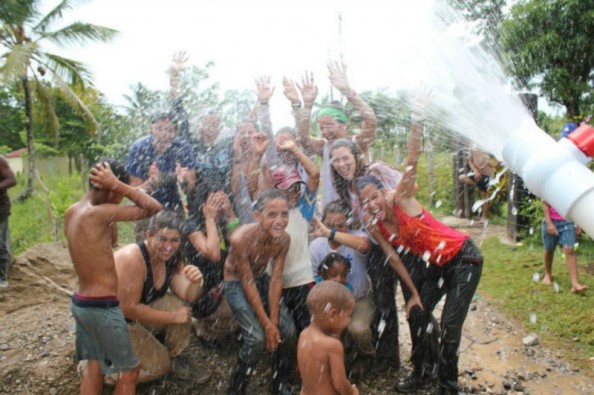
4) I will also include a few pictures of past trips in this post as per the request of one of the comments I received to give a better understanding of a BLUE trip
5) Two of the comments I received stated that my opportunity makes them want to start volunteering. I found this interesting as most people do not volunteer often. I have thus tried to adapt my Idea Napkin and Elevator Pitch to appeal to those who don't normally volunteer as a hobby.


Sunday, February 28, 2016

Week 8 Reading Reflection

1) What was the biggest surprise for you in the reading? In other words, what did you read that stood out the most as different from your expectations? 

The section "Dispelling Venture Capital Myths" was pretty surprising. I thought it was interesting that the text pointed out that venture capitalists invest in good ideas and good management, not just good ideas. I also thought it was surprising that venture capitalists will generally avoid investing unless the returns are very high. 

2) Identify at least one part of the reading that was confusing to you.

The section "Equity Financing" was confusing to me. I am not entirely familiar with many of the technical terms mentioned in the section so I wasn't able to gain much usable entrepreneurial knowledge from reading that section.

3) If you were able to ask two questions to the author, what would you ask? Why?

Do you think that the advantages outweigh the disadvantages for debt financing?
    
Which factors do you think are most critical for venture capitalists to use in the evaluation of new       ventures?

4) Was there anything you think the author was wrong about? Where do you disagree with what she or he said? How?

The author claims that venture capital firms do not want to own control of your company and tell you how to run the business. I am hesitant to think, however, that venture capitalists do not have solely their own financial interests in mind when making an investment. I would take everything a venture capitalist says with a grain of salt.